Saturday, August 11, 2012

The Cabin

Back on June 9 I posted photos of the completed foundation of the cabin.  By this time I had hoped we would be under roof and working on interiors.   But my builder has really let me down, and we didn't get started with framing until this week.  Here are a few photos of the work so far:


Although I am very disappointed in my builder and the progress to date, I am growing more and more excited about the cabin itself.  Nearly every worker who comes to the site says something like, "what a great place for a cabin."  I have to say I agree.  Now, if we can just get the cabin built!

Deer Vetch and Alyce Clover

As I've mentioned previously here and here, earlier this year I planted a mix of Joint Vetch and Alyce Clover in two small bottoms near the creek that forms part of the southern boundary of Chaplin Bend Farm.  The plan was to establish good warm-weather food plots in a secluded spot for my deer.  But I've been disappointed with the progress in those plots:  the stuff I planted took a long time to germinate and the weeds really took over in the meantime.  But all is not lost:  even though its taken most of the summer, the vetch and clover is now beginning to come along.


With any luck they'll get to seed before the first frost and I'll be able to mow the plots to set up re-seeding next Spring.  Here's hoping!


The Lakes Are Coming Along

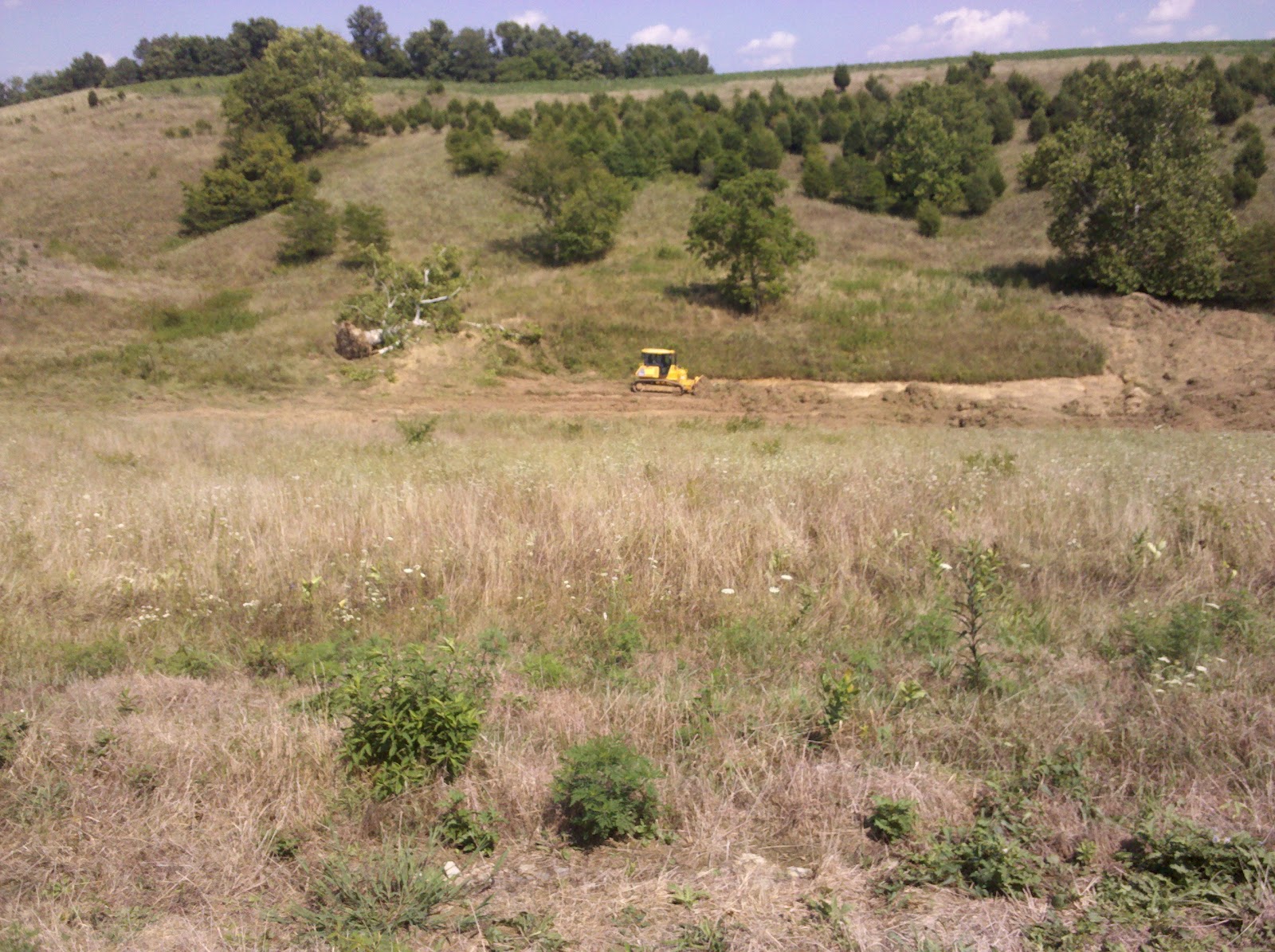
 Mel and his crew continue to work on the lakes project, raising the existing dam, building a new dam higher up in the valley, and building a wetland at the very top.  Here are some photos of the work on the existing dam:


Here's Mel at work on the core trench for dam 2:

And here's the through-drain for dam 2 (note the anti-seep collar and plastic water barrier):

More next week!

Friday, August 10, 2012

Beavers?

Yesterday I was inspecting my corn, driving the long perimeter between the corn field and the river in the Ranger, when I saw something odd:  a large section of corn had been taken down and eaten, and a long trail of corn stalks ran from the corn patch to the river.  Here are some photos:


At first I thought it was raccoons, but that didn't explain the cornstalks trailing away into the river.  So what else could it be?  Muskrats?  Maybe, but I'm not sure that a muskrat would be big enough to bring down a cornstalk.

Could it be a beaver?  Maybe.  The folks at Fish and Wildlife have told me that the Chaplin River has beavers.  But will beavers eat corn?  Turns out that they will.  So maybe we have a beaver or two living at the edge of Chaplin Bend.  I'll take a game camera down there when I get a chance and see if I can catch them in the act.


Saturday, August 4, 2012

Lakes

Finally, after months of planning, the lake project at Chaplin Bend is scheduled to begin in the coming week.  This project has three parts:  expanding and improving the existing lake by raising the dam about 3 feet and creating a better emergency spillway; adding a new, smaller lake above the existing one; and building a smaller "constructed wetland" at the top of the valley to divert some water that now flows out to the east down to the south into the other two lakes.

Mike Mattingly of Mattingly Engineering in Louisville did the engineering and design work for the project.  Here's a diagram of the plans for the three lakes. (I know its small and hard to read.  Click on the image to expand it.)


I've hired Mel Taylor of Smart Fish Farm of Auburn, Kentucky to do the construction work on the lakes. Mel is an experienced lake builder and something of an artist.   I'm looking forward to working with him.

Mel got the project underway this week.  The first step was to strip the top soil off of the existing dam to see what we had to work with.  The good news is that the existing dam was well constructed and appears to have no leaks.  It should serve as a great base on which to build the new, higher dam.  


Mel also began scouring the topsoil off the site of the middle lake.  As our tests indicated, there appears to be plenty of clay in the bed of the existing lake to build the new dam.  


I'll continue to post photos (and maybe movies) over the next few weeks as Mel completes the job.  I can't wait to see the final result!


Sunday, July 22, 2012

Food Plot Damage

I spent Friday at Chaplin Bend mowing weeds over my native grass plantings.  The point of that is to keep the weeds from shading out the desirable forbs and grasses and to keep the weeds from producing seeds.  I was nearly finished (for now--I'll need to mow again in a few weeks) when the hydraulic hose on my bush hog let go.  I'll try to get that replaced on Monday and finish the job.

While I was mowing I noticed lots of sericea lespedeza sprouting up in the areas where the fescue had been killed off.  Sericea is an invasive that has little or no food value for critters and spreads like wildfire.  I've already sprayed once, but it looks like this week I'll need to spray some more.  I'm afraid that suppressing the Sericea is likely to be a lifetime project.

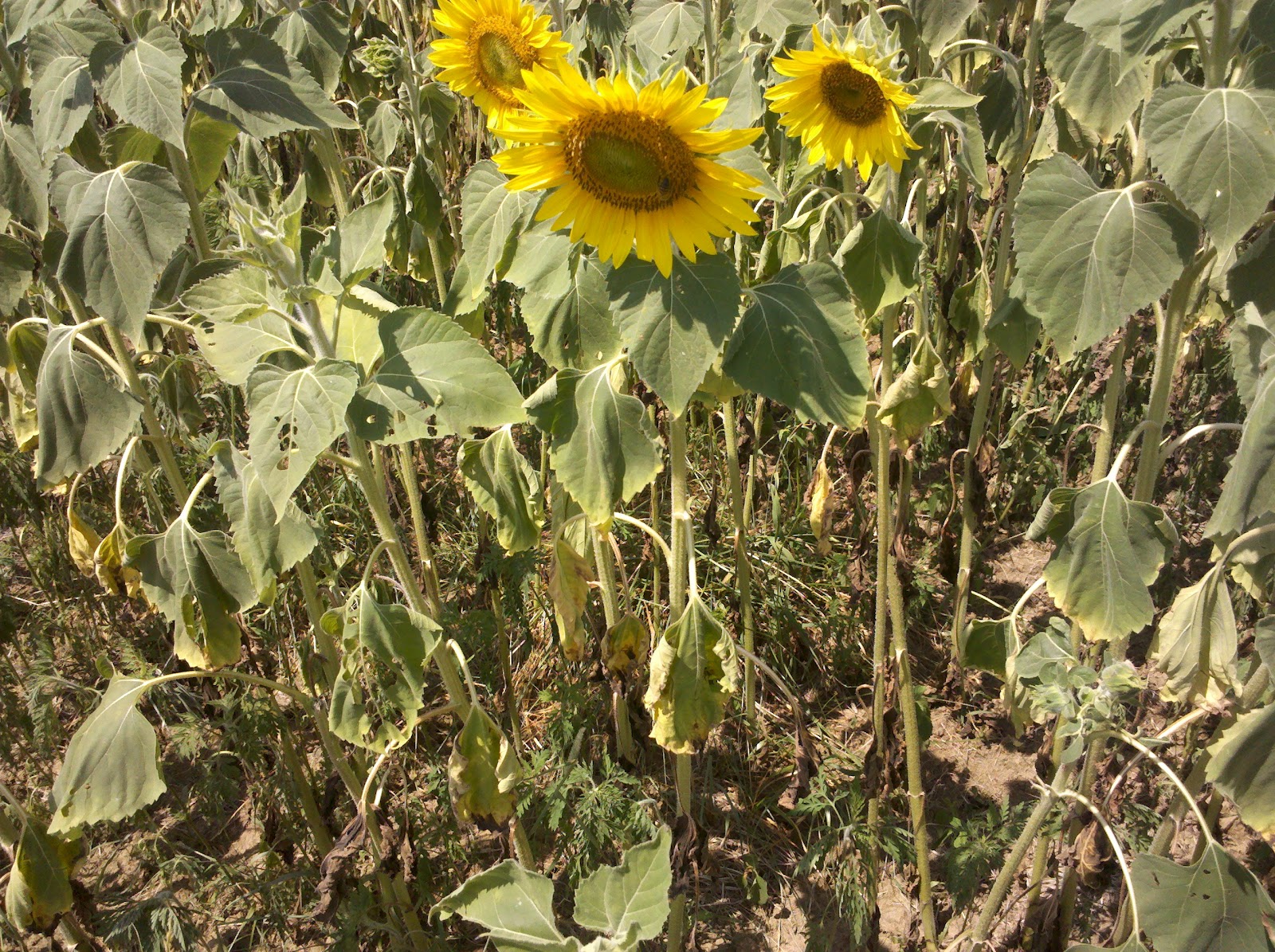
On Thursday of last week a severe thunderstorm hit the farm, dumping more than an inch of rain in a little more than an hour's time.  I was grateful for the rain but discovered that the storm had done some moderate damage to the sunflowers, bending them over in patches throughout the field, like this:

At first I thought it the damage was caused by deer or by a cow (more on that below) but the flowers on the broken stems are all intact--the stems are just broken off--and the damage is just not at the edges of the field but in patches throughout.  Likely the wind just pushed some of the flowers to the breaking point.  Even with the damage, though, the field is doing great, with the earliest flowers now moving toward maturity and later bloomers still in full florescence.  


The rain we received has everything looking good, and there are many doves in the field already, eating the seeds from the plants that had been blown down.  I'm a bit worried that the flowers are ahead of schedule--I want them to mature in mid-August and some may be mature by August 1--and things are still pretty dry at Chaplin Bend with little rain in the forecast, but I'm still hoping for a great crop in a few weeks.

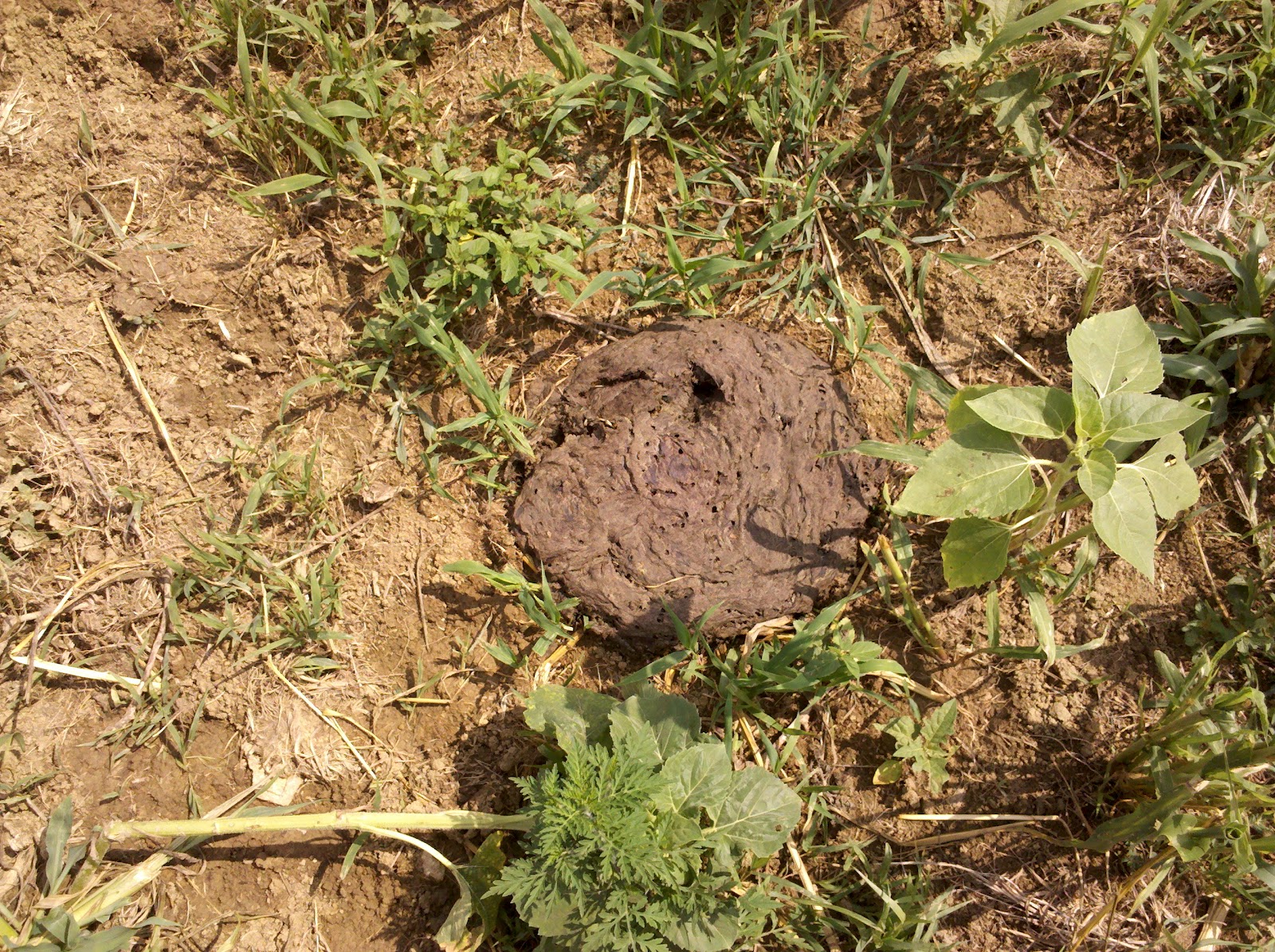
Things are not so rosy in the smaller plot where I planted the millet/milo/corn mixture.  Evidently one or more of my neighbor's cows got through the fence and decided to make a meal of my grains.  They are pretty much totally destroyed, grazed off a few inches above the ground:


How do I know it was a cow?  The evidence:


After discovering this I repaired the one opening I knew of in the fence that divides my farm from my neighbor's (nothing like shutting the barn door after the horse--or in this case, cow--has gotten out).  I hope not to see any more cows on Chaplin Bend for a while.  And maybe some of the grain will still produce some seed.

The rain was also good for the corn.  It appears to me that some areas will yield well (assuming a little more rain) while others will produce little or nothing, but there is no doubt that my crop is doing much better than that of most others in my area.  I am very thankful.


Saturday, July 7, 2012

Just Enough to Get By

Went to the farm this morning to check on the food plots.  And while things are still dry at Chaplin Bend, last night's rain helped a lot!  Thank you, Father, for giving me what I needed!

First, the sunflowers.  For the most part they seem healthy and vital.  A few leaves are curled and brown but most are full and green.  Nearly every plant now has a flower and the bees were busy doing their thing all over the place.


A few plants, especially at the edges where they are more exposed to the sun and the heat, look a little the worse for wear, but even those look like they'll make it if we get the rain we expect tomorrow and Monday.


I probably planted these sunflowers too densely, which exacerbates the drought problem--too many plants competing for too little water.  But an inch or so tomorrow should give all the flowers more than enough.

Just down the ridge from the sunflowers I planted about an acre of "wildlife mix" that I got for free from Brandon Campbell at NRCS.  I supplemented that with some Browntop Millet I had bought earlier in the Spring for another plot that I didn't have time to prepare, filling in a few empty spots. Well, that patch is thriving now.  The wildlife mix included corn, milo, millet, sunflowers, and soybeans, and at least the grains have come up well.  There are a few sunflowers, none anywhere close to making flowers, and a few soybeans, but the deer are hammering those.  The second seeding of millet is also coming in nicely, filling in around the mix.

 
In the bottoms by the small creek that forms my southern boundary, I planted two legumes, Alyceclover and Deer Vetch.  I planted those spots on May 12 and replanted again in mid-June when it appeared that the first crop had failed to germinate.  Finally, I'm beginning to see some progress, but both varieties are just beginning to grow past the seedling stage.  I planted these as warm-season plots and thought that they would be well along by now.  I had read that these varieties were slow to establish but...  Unfortunately, the slow progress of the desirables has allowed significant weed growth in the plots.  Oh, well, we'll see what happens over the coming weeks. Maybe next year we can do better.


Finally, the corn.  Most of the corn seems to be doing well:  tall and green with ears and tassels.  Other areas are not as healthy.  I'd say that maybe 80% of the crop looks good, with 10% looking stressed and maybe another 10% really looking bad.  The areas of stress seem to be in the west field, which I guess is more exposed to the afternoon sun and, in the wider places, has less direct exposure to the river.

Here's a view of part of the west field.  Notice the brown areas.


Here's a closer view at some of the worst parts of the west field.  Don't know if this can be saved, even if we get more rain tomorrow.


Here's an area further around to the south.  Everything looks healthy here.


And here's a section of the east field.  Looking good!


So it appears that the corn harvest will be mixed.  Perhaps the stressed areas will come along if we get some rain, but I doubt they'll yield much.  We'll see.

Next week we'll start mowing the fields where we planted native grasses to knock back the weeds and prevent them from seeding.  Should take a day or two to mow the whole thing.